
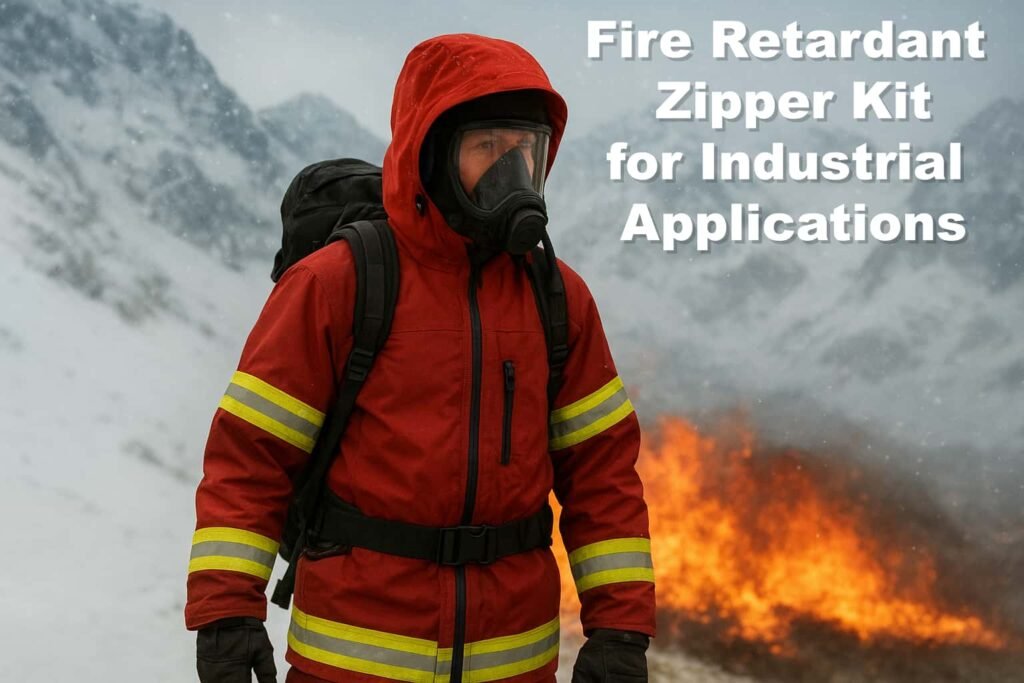
Fire Retardant Zipper Production Guide
Introduction & Importance of Fire Retardant Zipper Manufacturing
The Complete Engineering Guide for Protective & Industrial Applications
Introduction: Why Fire Retardant Zipper Manufacturing Matters
In high-risk environments such as firefighting, industrial safety, oil & gas, military operations, and protective workwear, every component of a garment plays a role in safety. While fabrics often receive the most attention, zippers are frequently overlooked—yet they can become a critical failure point when exposed to heat or flame.
A standard zipper may melt, ignite, drip molten material, or lose mechanical integrity under fire exposure. When this happens, the zipper can compromise the entire garment, increasing the risk of injury and preventing quick removal in emergency situations.
Fire retardant zippers are engineered specifically to address these risks. Their manufacturing process is not a simple surface treatment, but a carefully controlled system involving materials science, chemical treatment, mechanical engineering, and rigorous testing.
This pillar guide explains how fire retardant zippers are manufactured, step by step, from raw material selection to final quality validation—providing designers, engineers, and sourcing professionals with a clear, technical understanding of what separates true fire retardant zippers from ordinary alternatives.
What Is a Fire Retardant Zipper?
A fire retardant zipper is designed to:
- Resist ignition when exposed to flame
- Self-extinguish once the flame source is removed
- Prevent flame propagation along the zipper tape
- Maintain structural integrity and basic functionality after heat exposure
It is important to distinguish between:
- Fire retardant (slows ignition and flame spread)
- Flame resistant (inherently resistant at fiber level)
Most industrial fire retardant zippers combine treated materials and engineered structures to meet specific performance standards required by protective garment regulations.
Fire Retardant Zipper Step-by-Step Manufacturing Process
Step 1: Application Definition & Engineering Requirements
Manufacturing does not start on the factory floor—it starts with application analysis.
Before selecting materials, engineers define:
- End-use environment (temperature, flame exposure duration)
- Required safety standards (EN, ISO, NFPA, etc.)
- Garment type (coveralls, jackets, turnout gear, uniforms)
- Washing frequency and maintenance conditions
- Mechanical stress during use
For example:
- Firefighting gear requires short-term extreme heat resistance
- Industrial workwear may require repeated wash durability
- Military applications often demand lightweight construction with flame resistance
These parameters determine every technical decision that follows.
Step 2: Raw Material Selection
2.1 Zipper Tape Materials
Zipper tape is often the most vulnerable component in fire exposure.
Common fire retardant tape materials include:
- Flame-retardant treated polyester
- Flame-retardant treated nylon
- Inherently flame-resistant fibers (for high-end applications)
Key engineering goals:
- No sustained burning
- Minimal shrinkage under heat
- No dripping molten material
YGZIP engineers select tape materials based on compatibility with garment fabrics, ensuring consistent flame resistance across the entire product.
2.2 Teeth / Coil,Plastic,Metal Materials
Fire retardant zippers typically use:
- Nylon coil teeth (flexible, lightweight, suitable for garments)
- Plastic teeth(Polyoxymethylene (POM) with flame-retardant additive)
- Metal teeth (used when higher heat tolerance is required)
Engineering considerations include:
- Heat deformation resistance
- Tooth engagement stability after exposure
- No sharp edges after thermal stress
The teeth must remain mechanically stable, even if cosmetic changes occur.
2.3 Slider & Stop Components
Sliders are designed to:
- Resist deformation at elevated temperatures
- Avoid seizing due to thermal expansion
- Remain operable with protective gloves
Material options include:
- Heat-resistant metal alloys
- Specially formulated polymers with flame retardant additives
This is especially critical for emergency removal scenarios.
Step 3: Fire Retardant Zipper Tape Treatment
3.1 Why Tape Treatment Is Critical
Even if teeth and sliders survive heat exposure, a burning zipper tape can:
- Spread flames rapidly
- Create secondary burn hazards
- Cause garment structural failure
Therefore, tape treatment is a core engineering process, not an optional step.
3.2 Chemical Flame Retardant Treatment
This method involves:
- Impregnating flame-retardant agents into fibers
- Controlled curing to lock chemicals into the structure
- Multi-stage drying to ensure stability
Advantages:
- Cost-effective
- Suitable for industrial workwear
Challenges:
- Must maintain performance after washing
- Requires strict process control to ensure consistency
3.3 Inherently Flame-Resistant Fibers
For high-end applications, fibers are engineered at a molecular level to resist flame.
Advantages:
- No wash-out over time
- Consistent long-term performance
Limitations:
- Higher cost
- More complex sourcing
YGZIP evaluates both approaches based on performance-to-cost balance.
Step 4: Zipper Formation & Assembly
4.1 Weaving and Tape Preparation
Treated yarns are woven into zipper tapes using controlled tension and density to ensure:
- Uniform flame resistance
- Stable mechanical properties
- Compatibility with sewing and sealing processes
4.2 Coil ,Plastic or Teeth Formation
The coil ,plastic or teeth are formed and attached to the tape with attention to:
- Dimensional stability under heat
- No loosening or separation after exposure
- Smooth engagement along the entire length
This stage directly affects long-term reliability.
4.3 Slider Installation & Reinforcement
Sliders are assembled and tested for:
- Smooth movement
- Consistent locking performance
- Resistance to deformation
Additional reinforcement may be added for heavy-duty or emergency-use garments.
Step 5: Heat Exposure & Flame Resistance Testing
5.1 Flame Spread Testing
Typical tests include:
- Vertical flame testing
- Measurement of after-flame time
- Observation of flame propagation along tape
Passing criteria:
- Self-extinguishing behavior
- No sustained burning
- Limited damage zone
5.2 Heat Deformation Testing
Zippers are exposed to controlled heat levels to assess:
- Tape shrinkage
- Tooth deformation
- Slider integrity
This simulates real-world thermal stress.
Step 6: Mechanical Testing After Heat Exposure
Fire retardant performance is meaningless if the zipper fails mechanically afterward.
Tests include:
- Tensile strength
- Slider operation force
- Tooth engagement stability
YGZIP requires that zippers retain essential functionality after heat exposure.
Step 7: Washing & Durability Validation
Industrial garments are washed frequently.
Fire retardant zippers are tested for:
- Flame resistance after repeated washing
- Mechanical wear resistance
- Chemical stability of treatments
Only treatments that maintain performance over time are approved.
Step 8: Quality Control & Batch Traceability
Each production batch includes:
- Material certification records
- Process control documentation
- Test results linked to batch numbers
This traceability is critical for:
- Industrial compliance
- Long-term supply stability
- Customer audits
Common Misconceptions About Fire Retardant Zippers
“Any coated zipper is fire retardant”
False. Surface coatings alone do not provide reliable flame resistance.
“If the fabric is certified, the zipper doesn’t matter”
Incorrect. Zippers are often tested separately and can invalidate garment certification.
“Fire retardant equals fireproof”
No zipper is fireproof. Fire retardant means risk reduction, not immunity.
How to Specify the Right Fire Retardant Zipper
When sourcing fire retardant zippers, buyers should specify:
- Application environment
- Required standards
- Washing requirements
- Mechanical strength needs
- Color and design constraints
Early communication with zipper engineers prevents costly redesigns later.
Why Engineering-Driven Manufacturing Matters
Fire retardant zipper manufacturing is not a cosmetic upgrade—it is a safety engineering discipline.
Every step, from material selection to final testing, contributes to:
- Reduced injury risk
- Garment reliability
- Regulatory compliance
YGZIP approaches fire retardant zipper manufacturing as a system, ensuring that each component performs as intended in real-world conditions.
Conclusion: Built for Safety, Verified by Engineering
A fire retardant zipper is only as reliable as the process behind it.
Through engineered materials, controlled treatments, precision assembly, and rigorous testing, YGZIP manufactures fire retardant zippers that meet the demands of protective and industrial applications.
If you are developing garments where safety cannot be compromised, working with an engineering-driven zipper manufacturer is not optional—it is essential.
Looking for reliable fire retardant zippers for protective garments?
YGZIP provides engineered zipper solutions, testing support, and custom development for industrial, firefighting, and safety applications.
Need Fire Retardant Zippers for Your Project?
Whether you are developing:
- Firefighter gear
- Industrial protective clothing
- Military or tactical uniforms
👉 Contact our engineering team to discuss your application requirements.
👉 Request fire retardant zipper samples for testing for performance testing and certification validation.
👉Learn more about Fire Retardant Zippers products
👉ReadFire Retardant Zipper Applications
👉ReadFire Retardant Zipper – FAQ
YGZIP.COM
Functional Zipper Solutions for Real-World Applications
What is a fire retardant zipper?
A fire retardant zipper is a specialized zipper designed to resist ignition, slow flame spread, and reduce heat transfer when exposed to fire. It is manufactured using flame-retardant tapes, treated zipper teeth, and high-temperature-resistant sliders, complying with standards such as EN ISO 11612, NFPA 2112, or ASTM D6413.
How are fire retardant zippers manufactured?
How are fire retardant zippers manufactured?
What industries require fire retardant zippers?
Industries such as oil & gas, chemical processing, power generation, and steel manufacturing commonly require fire retardant zippers for worker safety.
